Shipping supply decisions begin with the shipment
For a New Jersey warehouse or shipping manager choosing supplies, begin with the shipped product, its packed weight and dimensions, how it travels, and how many units you send each month. Select a carton that leaves room for the needed cushioning, then specify closure tape, labels, and any pallet restraint. A printed ECT number or a carton dimension alone does not prove that a complete pack will survive transit.
Start with one representative shipment rather than a general shopping list. Record the product dimensions, fragile points, packed weight, current damage or packing problems, and whether the finished package travels as an individual parcel or on a pallet. Those details let a procurement manager compare complete pack designs instead of comparing box labels in isolation.
One Pack is a quote-only B2B distributor based in Edison, New Jersey. Its carton categories provide a starting point for a specification, but the buyer should confirm usable space, the packing method, and the required quantity before requesting a quote.
Sources: ASTM International, D5639/D5639M standard practice overview
Key takeaways for procurement managers
A useful shipping supply specification describes the packed unit and its distribution route. It also states which materials workers use together, so a carton change does not accidentally remove space needed for cushioning or change how the box is sealed.
The four decisions below form a short checklist for choosing a specification. They are starting points for a packing trial, not performance claims about any One Pack product.
Key takeaways
- Measure the product and the finished, sealed package; carrier measurements apply to the package being shipped.
- Choose carton dimensions and construction alongside the cushioning and closure method.
- Treat an ECT value as one board characteristic, not a universal safe load or stacking rating.
- Estimate demand in individual units, then compare that demand with the catalog's bundle quantities when preparing a quote.
Sources: UPS, Package Dimensions, Size Limits and Weight Guide; ASTM International, D5639/D5639M standard practice overview
Choose cartons by fit, construction and handling
Carton selection starts with the product plus the space required to protect it. Compare the catalog dimension with the packed product, then confirm the carton's usable interior dimensions before committing to a packing method. Measure the finished exterior as well: UPS instructs shippers to measure the package itself and uses its dimensions when determining dimensional weight.
The examples below show why a request for a box needs more than a length and width. The catalog includes regular slotted cartons, multi-depth cartons, and double-walled cartons with different stated ECT values and bundle quantities. These are catalog specifications, not promises that a given box will support a particular product weight or stack.
ECT describes a board characteristic relevant to box selection. ASTM's box-selection guidance considers the intended handling and environment, along with material and construction attributes; it does not turn an ECT label alone into a finished-package performance result. If stacking or rough handling is the concern, describe the actual conditions and evaluate the packed design.
| Catalog carton | Stated specification | Catalog bundle quantity |
|---|---|---|
| SKU BXR1295, RSC carton | 12 x 9 x 5 in; 32 ECT | 25 boxes |
| SKU BXR20A2, RSC carton | 20 x 18 x 12 in; 32 ECT | 10 boxes |
| SKU BS202012MD, multi-depth carton | 20 x 20 x 12 in; 32 ECT | 20 boxes |
| SKU BS241818HDDW, double-walled carton | 24 x 18 x 18 in; 48 ECT | 15 boxes |
Sources: UPS, Package Dimensions, Size Limits and Weight Guide; ASTM International, D5639/D5639M standard practice overview
Build the protective pack and specify its closure
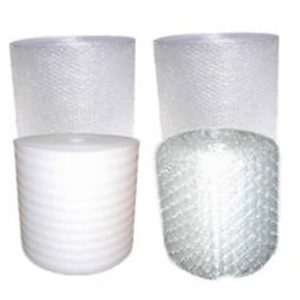
The protective pack needs to keep the item away from the carton's walls and limit movement inside it. A buyer can compare the available cushioning categories, then test a complete pack with the actual product. Material choice depends on the item's shape, fragile surfaces, weight, and the space left after it is placed in the box.
For a fragile parcel, consider whether a single carton provides enough clearance or whether a box-in-box design is needed. FedEx advises cushioning around breakable items, restricting movement, and using an H taping pattern on a standard corrugated box. Its guidance is a useful packing reference, but it is not evidence that any particular catalog carton has passed a transit test.
Closure belongs in the same specification as the carton. Identify the tape type and width, whether workers apply it by hand or with a dispenser, and which seams the packing instruction covers. The packing tape guide can help narrow that choice before the supply list is standardized.
Labels need their own space on the finished package. FedEx advises putting a shipping label on the largest surface and avoiding taped seams, so check the assembled pack before fixing a label position in a work instruction. If labels are printed at a packing station, include the printer and label format in the quote details.
Parcel and pallet shipments need different checks
Parcel shipments put the packed product through individual handling, so the product, cushioning, carton, and closure should be assessed as one unit. ISTA describes Procedure 3A as a test for packaged products distributed as individual parcels and Procedure 3B as a test for products moving through less-than-truckload distribution. A standard's overview helps identify a relevant test; it does not establish that One Pack has tested a product.
Pallet shipments add decisions about how cartons form a stable unit. Record the carton pattern, pallet footprint, stack height, and whether the load uses stretch wrap, strapping, or edge protection. A carton that works well as a single parcel still needs separate consideration when cartons are stacked and unitized.
Keep the two workflows distinct in a purchasing specification. State whether a SKU leaves the facility as a parcel, a palletized load, or both, then document the packing instruction for each route. For more on selecting film for a unitized load, see the stretch wrap guide.
Sources: International Safe Transit Association, Test Procedures
Turn shipment volume into a buying quantity
A replenishment estimate should start with actual shipment counts and a defined planning period. Count the cartons consumed by each packing method, then allow separately for samples, setup losses, and expected changes in demand. Keep those allowances visible instead of hiding them inside a vague monthly order estimate.
For example, suppose one packing method uses one SKU BXR1295 carton for each of 240 shipments per week, and procurement plans for four weeks. That is 960 cartons before any allowance. The catalog lists 25 boxes per bundle for this SKU and says it is sold by each, so 960 cartons correspond to 38.4 bundle equivalents; 39 full bundles would contain 975 cartons.
The example is a quantity calculation, not a recommended order or an inventory claim. Ask for a quote using the required number of individual cartons and note whether full-bundle handling is useful. Repeat the calculation for tape, cushioning, and labels using measured consumption from the chosen packing method.
Volume also affects how many carton sizes a team can manage consistently. If two SKUs can protect the same product, compare their finished outside dimensions, cushioning use, packing steps, and replenishment quantities before standardizing. The chosen design should be checked with the actual product and route, not selected from arithmetic alone.
| Planning input | Calculation | Result |
|---|---|---|
| Shipments | 240 per week x 4 weeks | 960 shipments |
| Cartons | 960 shipments x 1 carton | 960 cartons |
| Bundle equivalents | 960 cartons / 25 per bundle | 38.4 bundles |
| Full-bundle comparison | 39 bundles x 25 cartons | 975 cartons |
Sources: UPS, Package Dimensions, Size Limits and Weight Guide
Prepare a quote that can be matched to the job
A useful quote request connects each material to an application and a quantity. Give the sales team the packed product's dimensions and weight, the intended parcel or pallet route, the number of shipments per week or month, and any current packing failure. Include the carton SKU if one is already under consideration, but describe the problem it must solve.
List the equipment already in use, including tape dispensers, label printers, and any pallet-wrapping equipment. Specify whether packing is manual or machine assisted, and attach a simple packing sketch or photos if they clarify the fit. If a product is fragile or changes shape during packing, say so before comparing carton dimensions.
One Pack is based in Edison, New Jersey and handles B2B requests by quote. Send these details through request a quote or call 732-343-7857. A complete request makes it easier to compare the proposed supplies as one packing system.
- Product dimensions, packed weight, and the space needed for cushioning.
- Current carton size or SKU, closure method, label format, and pallet method where applicable.
- Expected quantity by item and planning period, stated in individual units.
- Transit route, handling concerns, and the failure the new specification should address.
Sources: ASTM International, D5639/D5639M standard practice overview
Frequently asked questions
Is a 32 ECT carton enough for my shipment?
The ECT label alone cannot answer that question. Assess the packed weight, product support, stacking, handling, environment, and complete package before selecting a carton.
Should I use the catalog box dimensions to calculate carrier dimensions?
Use the catalog dimensions to shortlist a carton, then measure the finished, sealed package for the carrier. The packed exterior can differ from the nominal carton size.
Can I request cartons without knowing the exact cushioning material?
Yes, if you provide the product dimensions, fragile points, and current packing method. Confirm the cushioning design and its required clearance before finalizing the carton specification.
What quantity should I put in a quote request?
State the number of individual units you expect to use over a defined period. Add the catalog SKU if known, and mention whether its listed bundle quantity matters to your handling process.