Start with the work area and garment label
For a warehouse or yard vest, start with where people walk, what vehicles move nearby, lighting, and the site's documented safety requirements. ANSI/ISEA 107 identifies garment Type by use setting and Class by visible material and design. Class 2 and Class 3 are different coverage choices, not automatic warehouse mandates. Verify the exact garment label before buying; a catalog title alone cannot establish its full ANSI designation.
This guide is for warehouse, facilities, and procurement managers who are choosing a vest specification or standardizing one across shifts. Walk the routes employees actually use: receiving doors, cross aisles, staging areas, and outdoor trailer lanes may have different sight lines and traffic. The purpose is to select an appropriate garment and gather the information needed for a quote. This is general information, not legal or compliance advice.
Key takeaways
- Choose the work setting and exposure first; then compare garment Type and Performance Class.
- Class 3 adds visible material and arm or combined-garment coverage beyond Class 2.
- A Class 2 product title does not establish its ANSI edition, Type, or verified label.
- Keep vehicle controls and pedestrian routes in the plan; a vest does not replace them.
Sources: ANSI, ANSI/ISEA 107-2020 standard overview; Ergodyne, low-visibility and struck-by hazards guide; 29 CFR 1910.178, powered industrial trucks
Type and Class answer different questions
ANSI/ISEA 107 Type describes the expected work setting, while Performance Class describes the minimum visible materials and garment design. The standard addresses background color, retroreflection, material placement, testing, and labeling. A bright color alone cannot tell a buyer whether a garment meets a particular Type and Class.
Type O is the off-road category, with Class 1 as its class option. Type R covers roadway exposure and has Class 2 and Class 3 options; Type P serves public safety responders and also has Class 2 and Class 3 options. A warehouse is not automatically a roadway work zone, and a private loading dock is not governed by the highway manual simply because trucks use it. The site assessment and any applicable contract, customer, or local rules determine the purchasing specification.
In a mixed operation, separate indoor, yard, and public-road tasks before choosing one company-wide vest. A person who sometimes enters a public roadway work zone may face a different requirement from a picker who stays inside a controlled building. Record where each role works and what apparel rule applies there, then check the Type and Class marking on the garment offered for that role.
Sources: ANSI, ANSI/ISEA 107-2020 standard overview; 3M, ANSI/ISEA 107-2020 Made Easier
Class 2 and Class 3 differ in coverage
Performance Class answers how much qualifying background and retroreflective material a garment provides and how that material is arranged. Class 2 provides more coverage than Class 1; Class 3 provides more than Class 2 and adds sleeve visibility or a qualifying combination with supplemental Class E apparel. Do not treat a wide strip, a fluorescent-looking fabric, or a product photo as proof of the whole garment's classification.
Use this comparison as a selection aid, not as a substitute for the standard or a garment declaration. The smallest compliant size may have a permitted background-material allowance, so a simple area number taken from another size can mislead a buyer. Ask the supplier for the exact item and size marking when the specification matters.
| Designation | What it signals | Buying check |
|---|---|---|
| Type O, Class 1 | Off-road garment with the lowest covered area in this set | Confirm that the exposure and site rule permit it |
| Type R or P, Class 2 | More visible background and retroreflective material than Class 1 | Confirm the Type, edition, size, and label |
| Type R or P, Class 3 | Greater garment coverage, with sleeve visibility or a qualifying Class E combination | Confirm the whole outfit meets the required class |
Sources: ANSI Webstore, ANSI/ISEA 107-2020 High-Visibility Safety Apparel; 3M, ANSI/ISEA 107-2020 Made Easier; Ergodyne, low-visibility and struck-by hazards guide
How should a loading dock or yard choose?
A receiving dock combines pedestrians, forklifts, parked trailers, and changing lines of sight. For an indoor picker who rarely enters vehicle lanes, document the actual exposure before writing a blanket vest rule. For a dock checker who walks behind trailers or across forklift routes, consider whether Class 2 coverage and garment contrast fit the assessed conditions. For a yard spotter who works in poorer light or more complex traffic, assess whether Class 3 apparel is the more suitable specification.
Those examples are purchasing scenarios, not legal class assignments. Lighting, vehicle speed, backing movements, weather, background color, and the distance at which drivers must detect a person all affect the choice. Evaluate the proposed garment in the actual view conditions without assuming that a vest alone controls the collision hazard.
Keep pedestrian routes, traffic rules, driver training, and sight lines in the same plan. The powered industrial truck rule includes pedestrian traffic in operator training and requires drivers to slow and sound the horn at cross aisles or other obstructed locations. It also requires a clear view in the direction of travel. A high-visibility garment supports that system but cannot create a clear path or stop a vehicle.
Sources: 29 CFR 1910.178, powered industrial trucks; ANSI Webstore, ANSI/ISEA 107-2020 High-Visibility Safety Apparel
OSHA does not assign one vest class to every warehouse
The general industry PPE rule in 29 CFR 1910.132 calls for a workplace hazard assessment and selection of covered PPE that fits the affected employee. It does not state that all warehouse workers must wear an ANSI Class 2 or Class 3 vest. Managers should document their own work areas, tasks, and applicable requirements instead of using a highway work-zone rule as a universal warehouse rule.
The federal highway manual addresses traffic control and worker apparel in roadway settings, a different context from an ordinary private receiving dock. If a team performs road work as well as warehouse work, review the current highway and state requirements for that task before specifying apparel. The ANSI label also identifies a performance standard; it is not, by itself, a complete legal determination for a workplace.
The assessment should include people who are easy to miss in a standard job-title list: visitors, contract drivers, temporary staff, and supervisors crossing the yard. Decide who supplies and checks their apparel, and explain when it is required. Revisit the choice when routes, lighting, equipment, or job duties change.
Sources: 29 CFR 1910.132, general PPE requirements; FHWA, current MUTCD edition
Match One Pack listings to a written specification
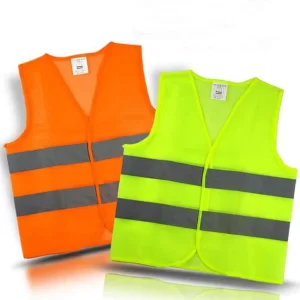
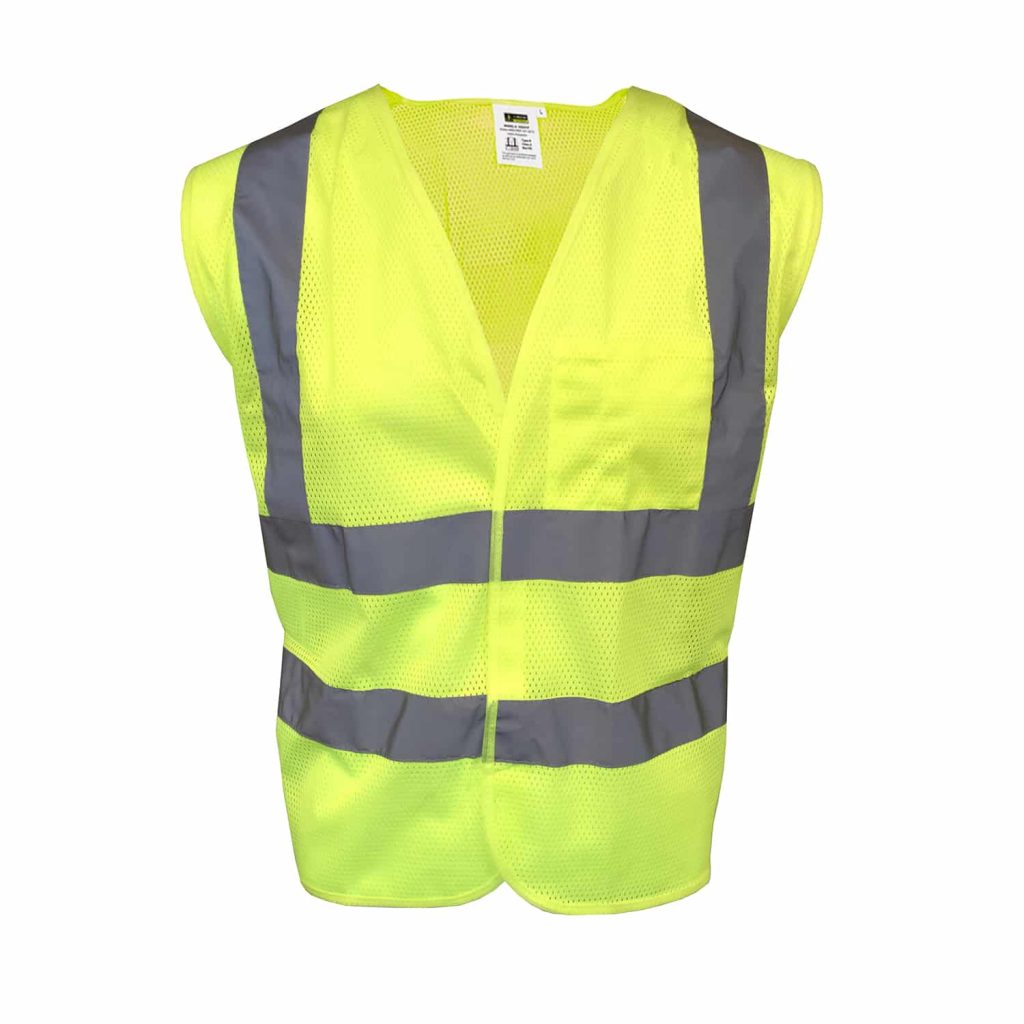
One Pack's safety vest category includes Class 2 listings in lime-green and orange. The lime-green Dual Strip Bottom Plain series has a Velcro closure and sizes from Small through 5X-Large; the orange Strip Plain series also has a Velcro closure and the same listed size span. Those descriptions can help build a size and color request, but they do not identify the garments' ANSI Type, edition, manufacturer declaration, fabric performance, or suitability for a specific task.
For example, the lime-green X-Large listing is SKU V241PXL, and the orange X-Large listing is SKU V210PXL. Request confirmation of the exact item's sewn-in marking and documentation if the purchase specification calls for ANSI/ISEA 107-2020 Type R, Class 2, or another designation. Do the same for every size being ordered; a shared product photo is not a size-specific conformity record.
If the assessed work calls for Class 3, do not relabel a Class 2 catalog listing as Class 3. Ask for a suitable Class 3 garment or for documented guidance on an eligible Class 2 plus Class E combination. The vests identified here are Class 2 listings; ask sales to identify a documented Class 3 option if needed.
Sources: 3M, ANSI/ISEA 107-2020 Made Easier; Ergodyne, low-visibility and struck-by hazards guide
Fit, care, and printing affect the final choice
A garment has to fit the worker and remain visible in use. Check that the closure stays shut over seasonal layers, the vest leaves the needed material exposed, and the wearer can move through the job without snagging or covering the bands. A loose vest, a jacket over the vest, or equipment that obscures the front or back can defeat the visibility the purchase was meant to provide.
Inspect vests for heavy soil, fading, torn fabric, and damaged reflective material. Follow the actual garment's care label and replace it when it no longer provides the intended visibility or is damaged. Avoid setting one universal replacement interval: exposure, laundering, and the manufacturer's instructions vary.
One Pack also has a printed safety vests category for buyers seeking a branded option. If a logo is requested, ask how its size and placement affect the visible material and the garment's claimed classification before approving artwork. Printing should not be assumed to preserve a marked Type or Class without the supplier's confirmation.
Sources: 3M, ANSI/ISEA 107-2020 Made Easier; Ergodyne, low-visibility and struck-by hazards guide
Build the quote from roles, sizes, and quantities
A useful quote request starts with the job, not only a color. Give One Pack the roles that need vests, whether they work indoors, on the dock, in a private yard, or in a public-road setting, and the minimum Type and Class established by your safety process. Add shift lighting, weather exposure, and whether an outer layer will cover the vest.
Then list the garment color, closure preference, sizes, quantity by size, and any printing plan. Include the exact SKU when you are matching an existing item, along with a request for current label and conformity details if your specification requires them. One Pack is based in Edison, New Jersey; a procurement manager can request a quote with this brief.
A broader PPE purchase may involve separate standards for other tasks. For hand protection, the cut-resistant glove levels guide explains a different selection problem. Keep each item tied to its own hazard and documented specification so a single vest class does not become a proxy for the whole safety program.
Frequently asked questions
Is a Class 2 vest required for every loading dock worker?
There is no universal Class 2 rule for every warehouse job in the cited general industry PPE provision. Assess each role's exposure and the rules that apply to that site, then write the required garment designation into the purchase specification.
Can a Class 2 vest become Class 3 by adding reflective tape?
Do not assume that field-added tape changes the garment's classification. Class 3 depends on the finished garment design and qualifying materials, and a Class 2 plus Class E combination has its own requirements. Obtain a labeled, documented solution.
Does a lime-green or orange vest automatically meet ANSI/ISEA 107?
No. Color in a catalog title does not verify the garment's materials, tested performance, edition, Type, or Class. Read the garment label and request the manufacturer's conformity information for the exact item.
What information should be sent for a vest quote?
Send the work setting, required Type and Class, size mix, quantities, color and closure choice, and any printing request. Include a known SKU if replacing an existing item, and ask for documentation when your specification requires it.
Sources: 29 CFR 1910.132, general PPE requirements; 3M, ANSI/ISEA 107-2020 Made Easier