Which box cutter is safest for warehouse work?
For a warehouse that mostly opens taped cartons, a concealed-blade cutter is usually the safest starting specification because the edge stays shielded during normal use. If the material or cut path will not fit its opening, assess a self-retracting design that withdraws the blade when cutting ends. No cutter removes the need for task checks, training, safe handling, and any hand protection indicated by the workplace hazard assessment.
Warehouse and procurement managers choosing a standard cutter should start with the actual opening task: tape only, carton board, film, strapping, or a mix. The lowest-exposure design that reliably finishes those cuts is the better candidate; a tool that jams, tears packaging, or invites workers to defeat its safety feature is a poor standard. This is a selection framework, not a claim that one model is safest in every workplace.
Key takeaways
- For routine opening, trial a concealed-blade design first and check that the material enters its guarded opening.
- If a guarded opening cannot complete the task, test a retracting blade with the smallest practical exposure.
- Check the blade state after each cut; 'self-retracting' describes different mechanisms.
- Document the PPE hazard assessment separately from the knife selection, then train for the chosen task and tool.
Sources: MARTOR, safety knife technologies; eCFR, 29 CFR 1910.132
Four blade designs compared
Blade exposure is the useful comparison for a shipping bench. A concealed edge remains behind a guard, while a retracting edge is exposed for the cut and then returns to the handle under the conditions set by its mechanism. Manual and fixed designs place more of the blade-state decision on the user.
The table is a task-selection aid, not an injury-rate ranking or a substitute for a trial. Manufacturers use different terms for retraction, so confirm exactly when a candidate's blade returns and whether a lock can leave it exposed.
| Design | During the cut | After the cut | Practical selection check |
|---|---|---|---|
| Concealed blade | Guard shields the edge; material must fit the opening. | Edge stays guarded. | Can it cut every routine tape, film, or board path without forcing? |
| Self-retracting blade | Edge extends into the material. | Returns automatically under the model's specified trigger. | Does it retract when the cut ends, including if the trigger stays pressed? |
| Manually retractable blade | Edge extends into the material. | User must slide or fold it away. | Can staff consistently retract it before carrying or setting it down? |
| Fixed exposed blade | Edge remains open. | Edge remains open until covered or stored. | Is there a task-specific reason a guarded or retracting option cannot work? |
Sources: MARTOR, safety knife technologies
Concealed blades fit many routine opening tasks
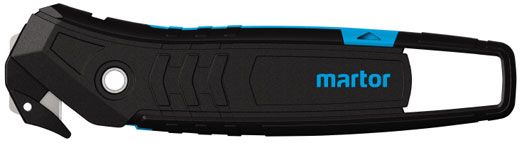
A concealed-blade cutter keeps the working edge inside a narrow cutting channel. That reduces ordinary hand contact with the edge and can help avoid slicing the goods inside a carton, provided the opening and cut path suit the material. It is a sensible first trial for repeated tape and light carton opening, but a guard does not make careless handling safe.
Watch the operator cut the real cartons, including taped corners and irregular seams. If the guard will not enter a tight seam, the worker may pull harder, twist the tool, or reach for an exposed blade; revise the tool choice or opening method rather than normalizing that workaround. Record which materials and cuts the guarded design completes without forcing.
One Pack's shipping-room knife category lists the Secumax 350 Safety Knife, SKU 350001.02, sold by each. Treat the catalog name as a candidate for a hands-on trial and confirm the current blade arrangement and replacement instructions before standardizing it.
Sources: MARTOR, safety knife technologies
Retraction changes what happens after a cut
A retracting knife exposes the edge while it is cutting, so hand position and the direction of travel still matter. Some mechanisms pull the blade back when the user releases a slider or lever; others withdraw it when the blade leaves the material even if the control remains pressed. Ask the supplier to identify the mechanism and demonstrate that behavior on the actual package.
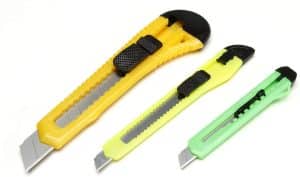
A manual slider depends on the user to retract the blade before walking, reaching into a bin, or putting the tool down. A fixed exposed edge has no retraction step at all, making a safe sheath or storage location especially important. Neither design should become the default merely because it feels familiar; compare its successful cuts and exposure with guarded alternatives.
The catalog also lists a Self-Retracting Plastic Utility Knife, SKU ARK, sold by each in boxes of 10, and a Secupro Merak Knife, SKU 124001.02, sold by each. Their names do not establish identical return mechanisms or interchangeable blades; confirm the exact current tool and replacement part before a quote. One Pack also lists Heavy Duty Metal Utility Knife, SKU M-KNIFE, sold by each in boxes of 12, for tasks that require a separately assessed utility-knife option.
Sources: MARTOR, safety knife technologies
The PPE assessment supports a documented choice
Knife standardization and the PPE hazard assessment are related decisions with different purposes. Under 29 CFR 1910.132(d), an employer assesses whether workplace hazards call for PPE, selects and communicates protective equipment where required, and verifies the assessment through a written certification identifying the workplace, certifier, and assessment date. That provision does not prescribe a particular box-cutter style or require a written certification of the knife choice itself.
For cutting tasks, document the materials, frequency, hand positions, nearby workers, and foreseeable slips or blade changes. Then consider whether a guarded tool changes exposure enough for the task and whether hands still face severe cut or laceration hazards. Under 29 CFR 1910.138, required hand protection must be chosen for the task, conditions, duration, and identified hazards; a glove label alone is not a selection.
Use the cut-resistant glove guide alongside the glove's own rating and instructions when evaluating hand protection. OSHA also makes employers responsible for the safe condition of tools used by employees under 29 CFR 1910.242(a). This article is general information for purchasing and workplace planning, not legal or compliance advice.
Sources: eCFR, 29 CFR 1910.132, general PPE requirements; eCFR, 29 CFR 1910.138, hand protection; eCFR, 29 CFR 1910.242, tool condition
Pilot the cutter before specifying a supply
A short, supervised trial should use the packages workers actually open, including the hardest routine cut. Check whether the blade reaches only as far as needed, whether the guard snags, whether the return mechanism works after each cut, and whether left- and right-handed users can control the tool. Record failed cuts and workarounds as carefully as successful ones; do not treat a manufacturer's safety label as proof of local performance.
Train workers to cut away from the body, keep the free hand outside the cutting line, and watch for people nearby. Set a designated place for cutters and used blades, and remove tools with damaged guards, loose parts, or failed retraction from use.
For procurement, specify the material to be cut, package dimensions and seam access, daily cutting frequency, worker handedness, required glove use, preferred blade mechanism, replacement-blade plan, and estimated quantities. For a standard cutter and replenishment plan, request a quote with those details and the candidate SKUs; One Pack is based in Edison, New Jersey. The packing tape guide can help identify the tape types the cutter must open.
Frequently asked questions
Is a recessed blade always the safest box cutter?
It is a strong first candidate for routine carton opening because the edge stays shielded, but the material must enter the cutting channel. If it cannot complete the real cut without forcing, trial another guarded or retracting design and reassess the work method.
Does self-retracting mean the blade disappears when I release the trigger?
It may, but designs differ. Some return when the control is released, while others retract as the blade leaves the material even if the control is still pressed; check the specific tool's instructions and test its action.
Will cut-resistant gloves make an exposed blade safe?
No glove makes a cut risk disappear. Select hand protection for the actual task and the product's own rating, and keep the free hand clear of the cutting path.
What should a buyer include in a box-cutter quote request?
Give the package and material types, seam access, expected cutter count, replacement-blade needs, glove requirements, and the blade mechanism being considered. Include any failed trial cuts so the proposed tool can address them.
Sources: MARTOR, safety knife technologies; eCFR, 29 CFR 1910.138, hand protection