Choose the hazard before the A level
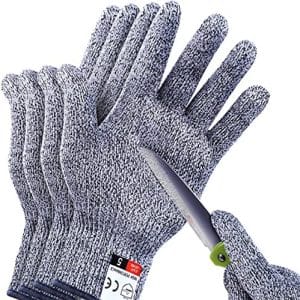
For warehouse and procurement managers choosing cut-resistant gloves, start with the task's blade exposure, then use ANSI/ISEA 105-2024 levels A1-A9 to compare tested cut resistance. Match the glove's own published rating, fit, grip, and other protection needs to the workplace hazard assessment; a higher A number alone does not make a glove suitable. OSHA requires hand protection selected for the task, conditions, duration, and hazards.
This guide is general information, not legal or compliance advice. The A scale is a comparison tool for a specific cut test, while the employer's selection still depends on the actual work and the rating of the exact glove being considered.
Sources: ISEA, Key to Hand Classifications for ANSI/ISEA 105-2024; 29 CFR 1910.138, Hand protection, via Cornell LII
ANSI/ISEA cut levels at a glance
ANSI/ISEA 105-2024 classifies tested cut resistance from A1 through A9. The ranges below are blade forces in grams-force, abbreviated gf, associated with cut-through in the specified test; they are not safe handling weights or promises that a glove cannot be cut.
The level is useful when comparing the same type of test result across candidate gloves. Use the chart to narrow a specification, then request the manufacturer's rating for the exact model and area of the glove that may contact an edge.
Key takeaways
- Start with the edge, motion, contact frequency, and likely contact area in the actual task.
- A2 begins at 500 gf; A4 begins at 1,500 gf under the cut test.
- A higher cut level does not establish puncture, chemical, heat, or impact protection.
- Confirm the exact glove's published rating before specifying a SKU.
| Cut level | Cut-test force, gf |
|---|---|
| A1 | 200-499 |
| A2 | 500-999 |
| A3 | 1,000-1,499 |
| A4 | 1,500-2,199 |
| A5 | 2,200-2,999 |
| A6 | 3,000-3,999 |
| A7 | 4,000-4,999 |
| A8 | 5,000-5,999 |
| A9 | 6,000 or more |
Sources: ANSI, ANSI/ISEA 105-2024 hand protection and cut level ratings; ISEA, Key to Hand Classifications for ANSI/ISEA 105-2024
Why A2 and A4 are not interchangeable
A2 starts at 500 gf in the standard's cut test, while A4 starts at 1,500 gf. That difference matters only in relation to the edge and contact pattern a worker faces; an A4 label does not automatically make every A2 task safer, and neither number tells you whether the glove will grip a wet carton or allow precise handling.
Consider two shipping-room tasks: folding clean corrugated cartons and clearing a jam near exposed metal strapping ends. They call for separate hazard assessments because the likely edge, hand position, contact frequency, and other hazards differ; the examples do not prescribe a grade for either task.
ASTM F2992-23 measures material response to a smooth sharp edge under specified loads. ASTM says that result does not represent serrated edges, saw blades, motorized cutting tools, puncture, or tear, so a warehouse manager should not treat an A level as proof against those hazards.
Sources: ANSI, ANSI/ISEA 105-2024 hand protection and cut level ratings; ASTM, F2992-23 cut resistance test method
OSHA requires a task-based selection
Under 29 CFR 1910.138, employers select and require appropriate hand protection where hands face hazards including severe cuts, punctures, chemical burns, and thermal burns. Section 1910.138(b) says selection must evaluate the glove's performance against the tasks, conditions, duration of use, and identified hazards; the rule does not assign an A level to a warehouse job.
The broader PPE rule, 29 CFR 1910.132(d), requires a workplace hazard assessment, selection of protective PPE, communication of that selection, and proper fit. It also requires a written certification that identifies the workplace assessed, who certified the assessment, its date or dates, and the document as a certification of hazard assessment.
A task-and-glove selection record is a practical way to connect the assessment to a purchase: name the task, exposed hand areas, edge type, other hazards, candidate model, published ratings, and reason for choosing it. The regulation specifically requires the written certification of the assessment; it does not say that every glove choice must be documented in that format.
Employers also must train affected workers on when PPE is needed, its limitations, and its care, and must keep damaged PPE out of use. Revisit the selection when the process, tool, material, or glove model changes enough to alter the exposure.
Sources: 29 CFR 1910.138, Hand protection, via Cornell LII; 29 CFR 1910.132, General requirements, via Cornell LII
Check protection beyond the cut number
A cut rating answers a narrow question about resistance to a blade test. If workers also face puncture, abrasion, chemical contact, heat, or impact, identify each exposure separately and ask for the product's applicable performance data; ASTM specifically warns that its smooth-edge cut method does not measure puncture or tear.
Fit and work method belong in the selection. Ask workers to try the candidate size while performing a controlled version of the task, and check that they can grasp the actual carton, strap, or tool without a loose fingertip or slipping grip; OSHA requires PPE that properly fits.
Check which part of the glove carries the stated cut rating, especially when the palm, fingers, and back have different materials. ISEA says the 2024 edition introduced a pentagon label that places the cut rating at the top, abrasion on the left, and puncture on the right; an X means a classification was not tested or is not applicable.
For any candidate, request the manufacturer's current product sheet and test or classification information for the exact model. Keep the rating with the selected SKU so a substitution does not silently change the protection basis.
Have the safety lead watch a controlled trial using the same hand positions and handling method as the real station, including where an edge could touch the palm, fingertips, or back of the hand. If the product sheet does not identify the tested area, seek clarification before assuming that every glove surface has the same cut performance.
Sources: ASTM, F2992-23 cut resistance test method; 29 CFR 1910.132, General requirements, via Cornell LII; ISEA, 2024 hand protection standard update
One Pack catalog options need rating confirmation
One Pack's cut-resistant glove category lists MCR Ninja models in large and extra large, while its work-glove listings include other gloves described as cut resistant. The catalog identifies sizes, knit gauges, and case quantities for the examples below, but it supplies no verified ANSI/ISEA A rating for these SKUs.
A knit gauge such as 10 gauge or 7 gauge describes the listed construction, not an A10 or A7 cut level. Do not infer a cut rating from the product name, fiber, gauge, or category; request the manufacturer's current rating for the exact SKU and the parts of the glove exposed by the task.
| Catalog item | Listed size and gauge | Listed case quantity |
|---|---|---|
| MCR Ninja N9676GL | Large; 10 gauge | 144 pairs |
| MCR Ninja N9676GXL | Extra large; 10 gauge | 144 pairs |
| MCR Kevlar Shell 9686L | Large; 7 gauge | 6 dozen pairs |
| MCR 9687S | Small; 10 gauge | 12 dozen pairs |
Prepare the glove specification and quote
Once the safety lead has narrowed the required protection, procurement can compare candidate models without losing the reason for the selection. Record the exact SKU, verified A rating, any other needed performance ratings, sizes by worker group, and the task for which each glove is approved.
For a useful request a quote, state the expected pairs used per shift or month, size mix, and target order quantity in pairs or cases. The catalog examples are sold by the pair, so asking for a case count alone can hide a mismatch between need and pack quantity.
Include a brief description of the materials and tools in use, such as cartons, strapping, and cutters, plus any wet or oily handling conditions. If cutters drive the exposure, the box cutter comparison can help frame the tool choice alongside the glove decision.
For a planning example, 12 workers using two pairs per week for four weeks need 96 pairs before any spare allowance. A model listed at 144 pairs per case would cover that calculated quantity in one case, but the example does not predict glove life or set a replacement interval; the task assessment and actual wear determine when a glove must be replaced.
- Task and exposed hand areas, including the type and movement of the edge.
- Required cut rating from the task assessment and the exact product sheet used to verify it.
- Other hazards and grip conditions, including puncture, abrasion, chemicals, or heat where present.
- Sizes, expected usage, and requested quantity in pairs and cases.
- Current glove model or other equipment in use, if standardizing or replacing a supply.
Frequently asked questions
Does OSHA require a specific ANSI/ISEA cut level for warehouse work?
No A level is named in 29 CFR 1910.138. Employers must select appropriate hand protection from the task, conditions, duration, and hazards, and the exact glove's published rating should support that choice.
Is A4 always better than A2 for handling cartons?
A4 has a higher cut-test threshold, but the right glove depends on the actual exposure, grip, fit, and other hazards. Assess the job and confirm the candidate glove's own rating before choosing either level.
Does 10 gauge mean a glove is cut level A10?
No. Ten gauge is a catalog knit specification, while the ANSI/ISEA cut scale runs from A1 to A9; the One Pack catalog entries here do not provide verified A ratings for the listed SKUs.
Will a cut-resistant glove protect against punctures or saw blades?
Do not assume so from an A rating. ASTM F2992's smooth-edge cut method does not represent puncture, serrated edges, saw blades, or motorized cutting tools, so check the product's separate ratings and the task-specific hazard assessment.
Sources: 29 CFR 1910.138, Hand protection, via Cornell LII; ANSI, ANSI/ISEA 105-2024 hand protection and cut level ratings; ASTM, F2992-23 cut resistance test method