OSHA 1910.23 is the warehouse ladder starting point
For warehouse and procurement managers selecting ladders, OSHA's general industry rule, 29 CFR 1910.23, is the starting point. Check whether the task needs a portable ladder or a mobile ladder stand, then confirm the applicable dimensions, load, stability, and inspection requirements. Inspect every ladder before its first use each work shift; remove defective units from service. This is general information, not legal or compliance advice.
A stockroom stepladder, a rolling picking ladder, and a fixed ladder attached to a building are different equipment types under the rule. Section 1910.23(b) gives requirements for all ladders, while paragraphs (c), (d), and (e) add requirements for portable ladders, fixed ladders, and mobile ladder stands or platforms. Treat the exact equipment design and work location as part of the selection decision.
Key takeaways
- Use 29 CFR 1910.23 for warehouse ladders and identify the ladder type before checking dimensions.
- Inspect before initial use each work shift, and repeat inspections more often when conditions require.
- Keep a portable ladder stable and protect it from aisle traffic; immobilize a mobile stand during use.
- Verify the selected product's own load rating, dimensions, and instructions before a quote or use.
Sources: Office of the Federal Register, 29 CFR 1910.23 (2025 edition)
Which dimensions apply to each ladder type?
Ladder dimensions depend on the type, so a single rung-width number cannot describe every warehouse ladder. The figures below are selected federal minimums or ranges from 1910.23; they are screening checks, not a substitute for reviewing the full rule and a specific product's specifications.
For ordinary ladder rungs and steps, OSHA measures spacing between centerlines. The general 10 to 14 in range has specific exceptions, including stepstools, and the mobile stand provision adds its own step geometry. Check which definition matches the equipment before comparing measurements.
| Equipment | Dimension to check | OSHA provision |
|---|---|---|
| Portable ladder | At least 11.5 in clear rung or step width | 1910.23(b)(4) |
| Fixed ladder | At least 16 in clear rung or step width, subject to listed exceptions | 1910.23(b)(4) |
| Mobile ladder stand or platform | At least 16 in step width | 1910.23(e)(1)(i) |
| Mobile ladder stand | Step rise at most 10 in; depth at least 7 in | 1910.23(e)(2)(i) |
| Ladders generally | Rung or step centerlines 10 to 14 in apart, subject to listed exceptions | 1910.23(b)(2) |
Sources: Office of the Federal Register, 29 CFR 1910.23(b) and (e) (2025 edition)
Portable ladders need stable placement and aisle controls
Portable ladders in a warehouse must be used on stable, level surfaces unless secured or stabilized against accidental displacement. OSHA also bars moving, shifting, or extending a ladder while an employee is on it. A stepladder must have a spreader or locking device holding its sections open, and neither its cap nor its top step may be used as a step.
When a ladder stands in a passageway, doorway, or other location where traffic could displace it, secure it or use a temporary barricade to keep traffic away. That is especially relevant where pickers share an aisle with carts or material handling equipment. A barricade is a control for the work area; it does not make an unstable or damaged ladder suitable for use.
Portable ladders used to reach an upper landing must have side rails extending at least 3 ft above that landing. Do not place a ladder on boxes, barrels, or another unstable base to gain height. These points matter when a short ladder looks convenient but does not fit the actual access task.
Sources: Office of the Federal Register, 29 CFR 1910.23(c) (2025 edition)
Rolling safety ladders have separate stand requirements
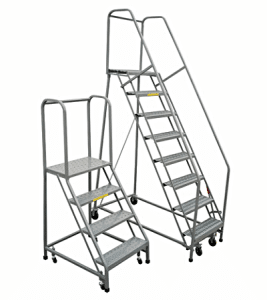
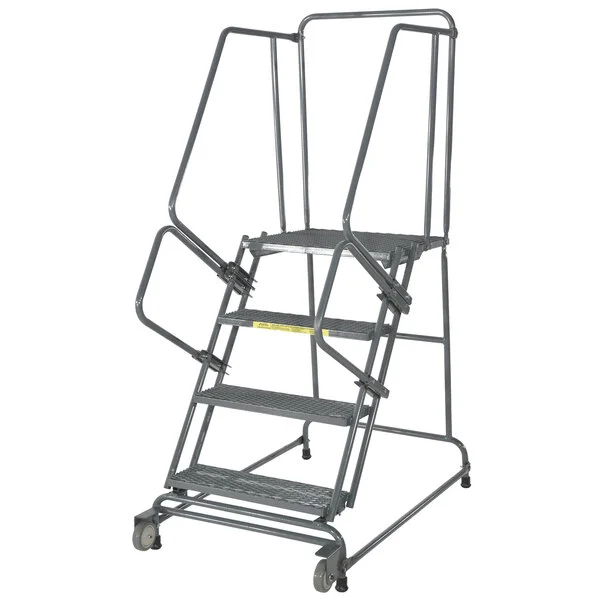
A warehouse rolling safety ladder may be a mobile ladder stand or a mobile ladder stand platform under OSHA's definitions. Both need slip-resistant steps and platforms, and a wheeled unit needs a system that impedes horizontal movement while someone is on it. The unit must not move with a person aboard, so wheel behavior is a specification and operating question, not merely a convenience feature.
For a mobile ladder stand, steps must be uniformly spaced, rise no more than 10 in, and have at least 7 in depth. Unless another provision applies, stands and platforms with a top step at least 4 ft high need handrails within the rule's specified height range. Additional top-step or platform protection applies at greater heights, so review 1910.23(e) for the actual configuration.
For procurement, One Pack's ladder category includes catalog examples such as the Ballymore Tilt and Roll 4-Step Gray Steel Rolling Safety Ladder, SKU TR-4P, and the Ballymore 4-Step Rolling Safety Ladder w/ Spring Loaded Casters, SKU FSH418XYELLOW. Those names identify catalog types; they do not establish a load rating, platform height, or OSHA conformity for a particular unit. Ask for the current product specifications before matching a ladder to the task.
Sources: Office of the Federal Register, 29 CFR 1910.21(b) and 1910.23(e) (2025 edition)
Inspections and training belong in the work routine
OSHA requires inspection before a ladder's initial use in each work shift and more often as needed to find visible defects that could injure employees. A defective ladder must be tagged with the rule's danger warning or similar wording and removed from service until properly repaired or replaced. A weekly checklist alone therefore does not replace the before-use shift inspection.
A useful inspection looks at steps, rails, feet, spreaders, and, on a rolling stand, wheels and the movement-impeding system. This is a practical checklist rather than a claim that each item has a separate inspection interval. Keep the inspection tied to the actual unit and its instructions, and isolate a suspect ladder immediately rather than leaving it in the picking area.
Under 1910.30(b), employers must train employees in the proper care, inspection, storage, and use of equipment covered by the walking-working surfaces subpart before use. Retraining is required when changed conditions or inadequate knowledge make earlier training insufficient. Training should cover the particular ladder types workers will encounter, including the need to face the ladder, grasp it with at least one hand while climbing, and avoid carrying a load that could cause loss of balance.
Sources: Office of the Federal Register, 29 CFR 1910.23(b) and 1910.30(b)-(d) (2025 edition)
Build the ladder quote around the task
A ladder quote should start with the task and location: shelf or landing height, floor condition, aisle width, traffic exposure, and whether workers need a standing step or a larger platform. Note whether the unit must roll between work points, how it will be prevented from moving during use, and where it will be stored. These details help narrow the equipment type before a step count is chosen.
OSHA prohibits loading a portable ladder beyond its maximum intended load; that load includes the worker and carried tools or materials. The regulation also sets structural capacity requirements for mobile ladder stands, but it does not tell buyers that any catalog model has a particular rating. Obtain the specific ladder's published rating and instructions, then compare them with the planned use.
For a quote from One Pack, based in Edison, New Jersey, provide the application, required working height, available floor space, quantity, and any equipment already in use. Include the proposed SKU if one is under review, then request a quote with those details. For a related warehouse hazard during stocking and unpacking, see the box cutter safety comparison.
Sources: Office of the Federal Register, 29 CFR 1910.23(c) and (e) (2025 edition)
Frequently asked questions
How often must warehouse ladders be inspected?
Inspect each ladder before its initial use in every work shift, and more frequently when necessary to identify visible defects. Tag a defective ladder and remove it from service until it is properly repaired or replaced.
What is OSHA's rung spacing for a warehouse ladder?
The general rule is 10 to 14 in between rung or step centerlines. OSHA lists exceptions, and mobile ladder stands also have specific step-rise and depth rules, so identify the ladder type before applying a number.
Is the portable ladder width rule the same for rolling stands?
No. OSHA's general minimum clear width for portable ladder rungs or steps is 11.5 in, while mobile ladder stands and platforms need at least 16 in step width. The equipment's classification controls which figure to check.
Can a rolling ladder be moved with a worker on it?
No. Under 1910.23(e), a mobile ladder stand or platform must not move while an employee is on it. A wheeled unit also needs a system that impedes horizontal movement during use.
Sources: Office of the Federal Register, 29 CFR 1910.23(b), (c), and (e) (2025 edition)