Choose by the layer's job
Choose packaging materials by the job each layer must do: a corrugated carton or mailer contains the item, cushioning controls movement and impact, bags or film cover or group it, and stretch wrap or strapping stabilizes a pallet. For warehouse and procurement managers choosing a standard pack, compare product dimensions, handling hazards, equipment, pack quantity and waste route. A listed material specification alone does not prove the packed shipment will survive transit.
Few shipments depend on one material. A small mailer may need an inner bag, while a pallet of cartons may need a layer pad and load stabilization. Define the finished pack before comparing individual materials, because an attractive component can still leave the contents free to move.
What should a buyer compare first?
Packaging buyers should start with the product and its route through the warehouse and carrier network. Record the item's dimensions, weight, fragility, sharp edges, moisture sensitivity and whether it ships singly, in a case or on a pallet. Then compare materials by the specific failure each is intended to prevent.
A useful specification describes the entire packing process. Note who applies the material, whether heat or a wrapping machine is available, and the number of packs needed per shift. Low material use per pack is useful only if the packed product remains protected.
Key takeaways
- Assign a job to each layer: containment, cushioning, covering, grouping or pallet stabilization.
- Compare dimensions and quantities in the catalog before asking for samples or a quote.
- Treat ECT, gauge and mil as material descriptors, not proof of finished-pack performance.
- Check the receiving route and local recycling option before standardizing a material.
Packaging materials by use and limit
The table compares packaging materials by their primary job, rather than treating them as substitutes. Catalog examples identify available formats and quantities; they do not establish that a material will work for every product or route.
Many packs use several rows of this table together. For example, a carton can provide a defined outer shape while a layer pad separates levels inside it and stretch film groups finished cases on a pallet. Confirm the actual pack layout before standardizing any one component.
| Material | Primary job | Check before choosing | Catalog example |
|---|---|---|---|
| Corrugated carton or mailer | Outer containment and a defined shipping shape | Packed size, closure, stacking and handling | 16 x 12 x 8 in 32 ECT carton; SKU BXR36TCARTON |
| Corrugated layer pad | Separation between products or case layers | Fit, edge exposure and remaining void | 13 7/8 x 13 7/8 in pad; SKU BSSP13 |
| Poly bag or tubing | Inner containment or covering | Opening, thickness and closing method | 4 x 6 in, 1.5 mil bag; SKU 461.5PBROLL |
| Poly sheeting | Surface cover or wrap | Sheet size, thickness and attachment | 64 x 64 in, 1 mil sheet; SKU 6464SHEETING |
| Shrink film | Tight product or multipack cover after heat | Heat equipment and product tolerance | 18 in, 60 gauge film; SKU 18X60APX |
| Stretch wrap | Grouping cases on a pallet | Hand or machine application and load shape | Hand film and machine film categories |
| Woven poly strapping | Tensioned band around grouped items | Contact edges, tools and product rating | 1 1/4 in x 600 ft strap; SKU 2035 |
Corrugated and cushioning start with the packed item
Corrugated cartons and mailers form the outer package for many individual shipments. One Pack lists a 16 x 12 x 8 in 32 ECT corrugated carton, SKU BXR36TCARTON, in bundles of 25, and an 18 x 18 x 18 in double wall carton, SKU BXR181818DW, in bundles of 15. Those descriptions are starting specifications, not promises about the weight or fragility a finished pack can withstand.
ECT is an edge crush measure used in evaluating corrugated board for stacking strength. The Fibre Box Association's ECT guide discusses its use alongside box compression; a 32 ECT designation alone does not establish the carrying capacity of a particular packed carton. Compare the box's construction, dimensions, contents, closure and stacking pattern before choosing a standard case.
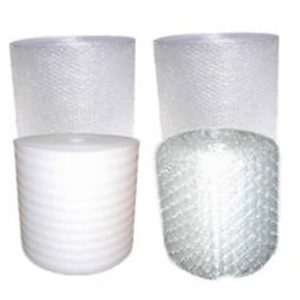
Cushioning and separation answer a different question: what happens to the item inside the outer box? A 13 7/8 x 13 7/8 in corrugated layer pad, SKU BSSP13, is listed in bundles of 100; it can separate layers, but it is not a complete solution for a fragile item with open space around it. Choose void fill or protective cushioning from the cushioning category based on the actual item and packing method.
Sources: Fibre Box Association, ECT Application and Reference Guide
Films, bags and strapping solve different problems
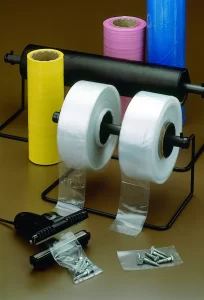
Films, bags and strapping serve different stages of packing. A poly bag or tubing can contain small parts or cover an item within a carton; sheeting covers a larger surface. One Pack lists 4 x 6 in, 1.5 mil pre-opened poly bags, SKU 461.5PBROLL, at 2,500 per roll, and 64 x 64 in, 1 mil poly sheeting, SKU 6464SHEETING, at 350 sheets per roll.
Shrink film tightens around a product or group after heat is applied. The catalog lists Flxtite 18 in, 60 gauge irradiated polyolefin APX shrink film, SKU 18X60APX, as one roll per case. Stretch wrap is applied under tension to help hold cases on a pallet; One Pack's stretch wrap and equipment categories distinguish hand film from machine film. These films require different application methods and should not be substituted on the basis of width alone.
Strapping groups or restrains a load with a tensioned band. The catalog lists 1 1/4 in x 600 ft heavy duty woven poly strapping, SKU 2035, with four coils per case. To choose among woven, plastic and steel strapping, record the load geometry, contact edges and tools in use; ask for the product's own performance information before deciding on a securement method.
Compare the full pack and verify performance
The most useful comparison is the complete packed unit in its expected distribution channel. List the outer container, internal protection, closure and any pallet stabilization, then pack a representative product with the actual operators and equipment. Observe whether the contents shift, the box deforms, film tears or the closure opens; record the material used per finished pack.
Preshipment testing provides a way to compare complete designs. ISTA lists Procedure 3A for individual parcel shipments and Procedure 3B for less-than-truckload shipments; its guidance emphasizes selecting a test that matches the real distribution environment and retesting when the product, package or process changes. A catalog rating or a successful sample pack should not be presented as a transit-test result.
Environmental comparisons also need a real disposal route. EPA advises checking the local recycling program for paper and cardboard and says plastic bags, wraps and films do not belong in household recycling bins; collection options vary. For a business, confirm what the facility's hauler accepts before describing a pack as recyclable in practice. Avoid assuming that every paper or plastic format has the same end-of-life path.
For a quote, send the product and finished-pack dimensions, expected units per shipment, monthly or seasonal volume, the equipment already in use and the distribution method. Include the carton style, film or bag dimensions, cushioning format and bundle or case quantities you want to compare. Review stock corrugated cartons and the packaging selection guide, then request a quote for the chosen formats.
Sources: International Safe Transit Association, Test Procedures; International Safe Transit Association, Getting Started with Design and Testing; US EPA, How Do I Recycle Common Recyclables
Frequently asked questions
Can a 32 ECT carton hold 32 lb?
No. The number describes an edge crush measure, not a universal packed-box weight limit. The carton size, construction, closure, contents and stacking conditions all matter, so evaluate the finished pack against its route.
Is shrink film the same as stretch wrap?
No. Shrink film conforms after heat is applied; stretch wrap is stretched around a load to hold it together. Ask which application equipment the warehouse has before specifying either film.
Does a poly bag replace cushioning?
A bag can contain or cover an item, but it does not by itself keep a fragile product from moving inside an oversized carton. Select a fitted outer pack and appropriate internal protection, then check the packed result.
When should a packaging design be tested again?
Retest when the product, package components, closure or packing process changes in a way that could affect performance. Also revisit the design if damage patterns or the shipping channel changes; choose a test method that reflects that route.
Sources: Fibre Box Association, ECT Application and Reference Guide; International Safe Transit Association, Getting Started with Design and Testing