Start with dispenser fit and daily use
For facilities and procurement managers choosing multifold paper towels, start with the dispenser's accepted fold and sheet dimensions, then compare sheets per case and actual towels used per visit. A larger pack count does not prove a longer reorder cycle, and a shared 548W label does not prove two catalog entries are identical. Test dispensing in the installed unit before standardizing a refill.
The purchase decision has two parts: whether a towel feeds reliably from the existing dispenser, and whether its case quantity suits the site's replenishment cycle. A restroom manager replacing an established refill should record the current towel label and dispenser model; a buyer equipping a new washroom can select towel and dispenser together. Either way, use a small on-site dispensing check before applying one specification to every location.
Key takeaways
- Match fold, sheet dimensions, and dispenser opening before comparing cases.
- Use towels per case, not packs per case, for a like-for-like supply calculation.
- Measure actual sheets taken per hand dry; do not assume every visitor uses one.
- Request fiber-content documents before describing a particular towel as recycled.
Fold format changes the refill decision
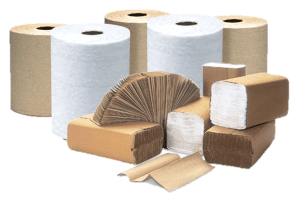
Multifold, C-fold, and roll towels are different refill formats, so the installed dispenser narrows the useful choices. A folded towel that looks similar on a shelf may feed differently once loaded, while a roll towel requires a roll-compatible unit. Treat the fold name as a starting point and the dispenser's stated refill dimensions as the deciding specification.
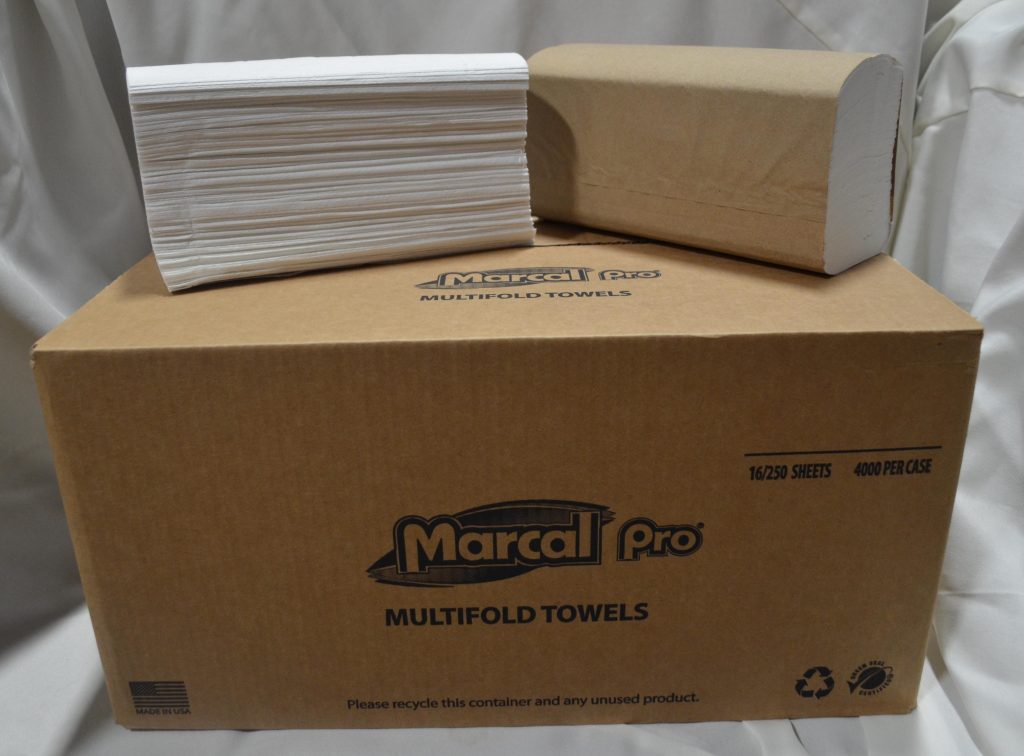
The One Pack catalog lists Marcal Pro Multifold Paper Towels, 548W, at 9.25 in x 9.5 in and 4,000 towels per case. It also lists VonDrehle Preserve White Multi-Fold Towels under SKU 548W with 16 packs per case, and Von Drehle White Multi Fold Towels, SKU 545-W, with 32 packs per case. Those entries give different fields, so their sheet counts and interchangeability cannot be inferred from the shared fold description or the 548W text.
For a site already using C-fold towels, the catalog lists Scott White C-Fold Paper Towels at 2,400 towels per case and Kleenex White Paper C-Fold Towels at 2,400 towels per case. These are useful comparison points for ordering quantities, but their case counts do not establish dispenser compatibility with a multifold towel. Review the paper products catalog with the current refill record beside it.
| Catalog entry | Listed case information | What to check before switching |
|---|---|---|
| Marcal Pro Multifold Paper Towels, 548W | 9.25 in x 9.5 in; 4,000 towels per case | Sheet size and actual feed in the dispenser |
| VonDrehle Preserve White Multi-Fold Towels, SKU 548W | 16 packs per case; towel count not listed | Sheets per pack and dispenser fit |
| Von Drehle White Multi Fold Towels, SKU 545-W | 32 packs per case; towel count not listed | Sheets per pack and dispenser fit |
| Scott White C-Fold Paper Towels | 2,400 towels per case | Whether a C-fold refill is specified |
Dispenser fit is a physical check
Dispenser fit depends on more than the word 'multifold' on a carton. Compare the dispenser's accepted towel width and fold type with the towel's published dimensions, then inspect how the loaded stack sits under the dispensing opening. A stack that is too tight, too loose, or loaded in the wrong orientation can make the refill hard to pull even if it fits inside the cabinet.
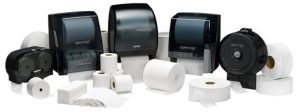
The catalog includes a Chrome C-Fold/Multifold Towel Dispenser, SKU SJMT1900XC, and a Black Pearl Plastic Countertop Folded Towel Dispenser, SKU SJMT1720TBK. Their names identify the intended general format, but the catalog bundle does not give an accepted sheet-size range or confirm a particular refill pairing. Ask for the dispenser's refill specifications before buying either unit for a towel already selected.
For a practical trial, load a normal stack, pull several towels in succession, and check whether each comes out without tearing, dragging extra sheets, or dropping the next sheet back into the cabinet. Repeat when the dispenser is nearly full and nearly empty, because the feed can feel different at each point. Record the dispenser model, towel description, and any jams so another site can reproduce the choice rather than relying on a vague note that the towel 'fits.'
Keep the trial focused on what the team can observe. It can establish whether a refill works in a particular installed unit, but it cannot by itself establish fiber content or a universal absorbency rating. If sites have different dispenser models, identify each model before consolidating their towel orders.
Case quantities need common units
Case quantity becomes useful only after it is expressed in towels, not just packs or cartons. The Marcal Pro 548W catalog entry states 4,000 towels per case, so a buyer can divide estimated towel use by 4,000 and round up to whole cases. The separate VonDrehle 548W entry states 16 packs per case but gives no sheets per pack in the bundle; it cannot support the same calculation without that missing value.
An example shows the method without pretending to predict every restroom. Suppose one facility records 240 hand-drying visits per workday, an average of two sheets per visit, and 20 operating days in a planning month. That is 240 x 2 x 20 = 9,600 sheets before any allowance for variation, restocking delays, or unusual events.
At 4,000 sheets per case, 9,600 sheets requires three whole cases. At 2,400 sheets per case, the same demand requires four whole cases, provided the dispenser accepts that C-fold format. The lower number of cases does not establish lower cost, better dispensing, or lower waste; those depend on the actual quote and observed use.
| Input or option | Calculation | Result |
|---|---|---|
| Planned towel demand | 240 visits x 2 sheets x 20 days | 9,600 sheets |
| Marcal Pro 548W multifold | 9,600 / 4,000; round up | 3 cases |
| Scott White C-Fold | 9,600 / 2,400; round up | 4 cases |
| VonDrehle Preserve 548W multifold | Sheets per pack not in catalog bundle | Cannot calculate yet |
Hand drying belongs in the facility plan
Hand drying is part of a usable handwashing station, so towel planning should be coordinated with sinks, soap, dispensers, and waste receptacles. CDC advises providing a way to dry hands and says that both a clean towel and an air dryer are effective ways to do it. CDC also says the evidence does not establish that either method is more effective at reducing germs on hands; the key is to dry hands completely.
That guidance does not establish that one named towel is more hygienic, more absorbent, or less wasteful than another. In a facility trial, count how many sheets users actually take and note whether a towel separates cleanly from the dispenser. If a comparison includes an air dryer, keep the discussion about site layout, maintenance, and observed use rather than claiming that paper towels prevent illness better.
Restroom placement also affects the supply plan. A dispenser that is difficult to reach or frequently empty undermines the intended drying option, regardless of its case count. Include the towel and dispenser in the broader janitorial supply checklist when setting inspection and refill routines. This is general facility purchasing information, not health or compliance advice.
Recycled-content claims need documentation
Recycled content is a procurement specification, not a conclusion to draw from a product name or the color of a towel. The supplied Marcal Pro 548W catalog fields do not state its recovered-fiber percentage, postconsumer-fiber percentage, or processing method. Ask for a current manufacturer document that identifies the exact item before putting any of those attributes in a purchasing requirement.
EPA's recovered-materials guidance treats total recovered fiber and postconsumer fiber as separate measures for commercial paper towels. The postconsumer share is included within the total recovered share, rather than added to it. A buyer writing a bid or internal standard can ask suppliers to state both percentages for the proposed towel and attach the document that identifies the exact product.
A purchasing team can also state the performance it needs, such as acceptable dispenser feeding and a measured sheet-use range, then evaluate a proposed recycled-content towel against those needs. EPA advises procuring agencies to consider reasonable performance requirements rather than letting unnecessary appearance standards bar recovered-fiber products. That is a framework for evaluating options, not evidence that any One Pack catalog item meets a particular environmental standard.
Do not treat an unsupported environmental description as a proxy for actual towel yield or dispenser behavior. Keep the requested fiber percentages, the exact item identifier, the manufacturer's documentation, and the observed refill results in separate fields of the purchase record. That makes future substitutions easier to review without silently transferring one item's claims to another.
Sources: US EPA, Consolidated Recovered Materials Advisory Notice, paper products sections
A quote needs usage and equipment details
A useful towel quote starts with the installed equipment and the amount the facility expects to consume. Give the dispenser model or a photo of its refill label, the current towel name, any known sheet dimensions, and the fold format. Add the number of washrooms, operating days, estimated sheets per month, and the desired case quantity; identify locations with different dispensers rather than assuming one refill will work everywhere.
For an existing Marcal Pro 548W buyer, the catalog's 4,000-towel case figure provides a starting unit for the request. If the facility is considering the separate VonDrehle 548W or 545-W listings, ask for sheets per pack and per case before comparing coverage. If a new dispenser is also needed, specify whether it will be wall mounted or countertop and request written confirmation of its accepted towel dimensions.
Restock planning should use actual withdrawal, not a universal claim about how many towels a person needs. Record a short baseline over representative busy and quiet days, calculate monthly use, and allow for the facility's own replenishment lead time and storage capacity. Recheck after changing either towel or dispenser, because the sheet-use average may move even when visitor counts stay similar.
Send those details through request a quote and point to the Marcal Pro 548W catalog entry if it is the intended item. One Pack is based in Edison, New Jersey, and the goal of the request is to identify a compatible refill and a practical case quantity. Keep the resulting item identifier, pack count, and dispenser pairing on the purchase record so the next order refers to the same specification.
Frequently asked questions
Can a multifold towel replace a C-fold towel in the same dispenser?
The fold names alone cannot confirm a swap. Check the dispenser's accepted refill dimensions and test feeding with the proposed towel before changing a site's standard.
Are the two catalog entries marked 548W the same towel?
The bundle lists a Marcal Pro 548W item with 4,000 towels per case and a separate VonDrehle Preserve SKU 548W item with 16 packs per case. It does not establish that their sheet counts, dimensions, or specifications are identical.
How many cases should a facility request?
Multiply hand-drying visits by observed sheets per visit and operating days, then divide by verified sheets per case and round up. Add the facility's own reserve based on its refill schedule and available storage.
Are paper towels safe to flush into a septic system?
No. EPA lists paper towels among items that should never be flushed because they can clog a septic system; place used towels in a waste receptacle.
Does the catalog confirm that Marcal Pro 548W has recycled fiber?
The supplied catalog fields do not document recovered-fiber or postconsumer-fiber percentages for that item. Ask for a current manufacturer document tied to the exact product before making a recycled-content claim.