Choose by load, route and anchor points
Choose a ratchet strap by the cargo's weight and shape, its route over or directly to the load, the vehicle's anchor points, and the working load limit (WLL) of the complete assembly. Check the federal minimum tiedown count separately from the WLL calculation. The strap must also reach without a poor hook fit or exposed webbing at a sharp edge. Confirm the actual product rating before use.
This guide is for warehouse, shipping and procurement managers specifying reusable cargo securement for commercial vehicle loads. It is general information, not legal or compliance advice; the applicable federal rule, any commodity-specific rule, the vehicle and the strap's own rating govern the load plan. A ratchet draws webbing through a tensioner, while end fittings connect the assembly to suitable anchor points.
Sources: FMCSA, Cargo Securement Rules; 49 CFR 393.108, Determining the WLL of a tiedown
Key takeaways for a purchasing spec
A purchasing spec should describe the whole securement path, not just a webbing width. Record the load dimensions and weight, the number and location of anchor points, and whether the strap crosses the load or attaches directly to it.
If one route depends on an unverified anchor or a hook that cannot seat correctly, revise the route before ordering. Keep the load plan and the selected SKU together so replacement purchases use the same checked specification.
Key takeaways
- Verify the WLL of the complete strap, hardware and anchor points; width alone does not establish capacity.
- Meet both the aggregate WLL requirement and the separate minimum tiedown count.
- Match flat hooks, S hooks, spring-loaded logistic ends or chain anchors to the equipment actually in use.
- Add edge protection where contact with the cargo could cut or abrade the webbing.
Sources: FMCSA, Cargo Securement Rules
Working load limit is a system calculation
For the general federal rule, aggregate WLL must equal at least half the cargo weight. A tiedown from a vehicle anchor to a cargo anchor contributes half its WLL; a tiedown passing over the cargo to an anchor on the opposite side contributes its full WLL. An over-the-top tiedown that returns to an anchor on the same side contributes half its WLL. These are calculation rules, not the amount of tension to apply with the ratchet.
For a hypothetical 4,000 lb article, the aggregate threshold is 2,000 lb. The table assumes every complete tiedown and its anchor points have a verified 1,000 lb WLL; it assigns no WLL to a One Pack SKU. Two opposite-side over-the-top tiedowns meet the WLL threshold in this example, while two direct tiedowns do not. Geometry, restraint against all directions and the minimum count still need separate checks.
The effective WLL is limited by the lowest-rated component, including the tensioner, connector and anchor point. Use the manufacturer's marking or the governing rule to determine WLL; do not substitute a breaking-strength figure or infer a rating from strap width. If the rating of a component cannot be established for the planned use, leave it out of the calculation until it is confirmed.
| Tiedown route | Calculation | Aggregate WLL |
|---|---|---|
| Two straps over cargo to opposite-side anchors | 2 x 1,000 lb | 2,000 lb |
| Two straps from vehicle anchors directly to cargo anchors | 2 x 500 lb | 1,000 lb |
| Four straps from vehicle anchors directly to cargo anchors | 4 x 500 lb | 2,000 lb |
Sources: 49 CFR 393.106, General requirements for securing cargo; 49 CFR 393.108, Determining the WLL of a tiedown
How many tiedowns does the load need?
Tiedown count is a second test under the general rule for an article that is not blocked against forward movement. An article up to 5 ft long and no more than 1,100 lb needs at least one; an article up to 5 ft but over 1,100 lb needs at least two. An article longer than 5 ft and no longer than 10 ft also needs at least two. Those are minimums, so the WLL calculation or load behavior can require more.
For an unblocked article longer than 10 ft, use at least two tiedowns for the first 10 ft and one additional tiedown for each further 10 ft or fraction. When an article is properly blocked against forward movement, the general rule calls for at least one tiedown per 10 ft or fraction. Certain cargo has more specific federal requirements, so identify the commodity before applying this shorthand.
Sources: 49 CFR 393.110, Minimum number of tiedowns; FMCSA, Cargo Securement Rules
Match hook, length and case quantity
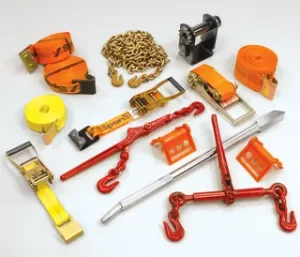
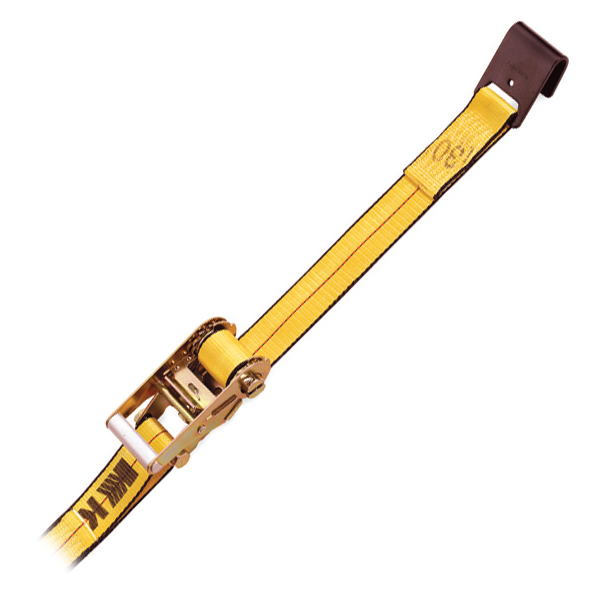
The cargo control selection includes distinct end fittings and lengths. Match the fitting to the vehicle's actual attachment point, then measure the route over or to the cargo with enough length for the ratchet to take up slack. A nominally longer strap does not resolve an incompatible anchor, and the product title does not establish WLL.
The examples below are catalog identifiers for comparing formats and ordering quantities. Request the current rating and assembly details for the chosen SKU before assigning it to a load. A logistic strap, a flat-hook strap and a chain-anchor strap answer different attachment needs; selecting by case quantity alone would miss that fit.
Cargo securement straps serve a different purchasing purpose from coil strapping used to unitize packages. Managers comparing those supplies can review the plastic strapping guide separately. Keep the quote request clear about whether the need is vehicle tiedowns, package strapping or both.
| SKU and listed strap | Listed dimensions | Listed case quantity |
|---|---|---|
| 711587PK - Kinedyne vinyl coated S hook ratchet utility strap | 1 in x 15 ft | 20 straps per case |
| 642001 - Kinedyne spring loaded logistic ratchet strap | 2 in x 20 ft | 20 straps per case |
| 512720 - Kinedyne flat hook ratchet strap | 2 in x 27 ft | 8 per case |
| 593040 - Kinedyne chain anchor ratchet strap | 4 in x 30 ft, with 18 in chain | Confirm for quote |
Inspect, tension and protect the webbing
Inspect the webbing, stitching, hooks, ratchet and anchor points before use. The federal rule requires securement components in proper working order without damage that would weaken them, and it prohibits knots in tiedowns. Remove a damaged assembly from the job until it is assessed under the applicable rule and manufacturer instructions. Store straps so the next user can inspect the full length and the hardware.
Route the webbing without twists that obscure contact areas, connect the fittings to appropriate anchors, pull out slack and operate the ratchet according to its instructions. Secure the handle so the tiedown cannot loosen or release in transit; avoid tension that damages the cargo or hardware. Where the webbing could be cut or abraded against an edge, use protection that resists cutting, abrasion and crushing. One Pack also lists edge protectors and a Kinedyne plastic corner protector, SKU 37025, in the catalog.
For covered commercial vehicle operations, 49 CFR 392.9 calls for an inspection within the first 50 miles and further checks when duty status changes, after 3 hours, or after 150 miles, whichever comes first. The rule contains exceptions for certain sealed or impracticable-to-inspect loads. A shop procedure should identify who checks tension and what to do when the cargo settles or a fitting shifts.
Sources: 49 CFR 393.104, Standards for cargo securement devices; 49 CFR 392.9, Inspection of cargo and securement devices
Prepare a quote from the load plan
A useful quote request begins with the load's weight, length, width and height, then describes the vehicle, anchor locations and the intended tiedown route. Include any known anchor ratings, the required complete-assembly WLL, preferred end fitting, measured strap length and expected straps per load. Attach a photo or drawing of an unusual anchor or sharp cargo edge if that will prevent a fit mistake.
For replenishment, provide the SKU already in use, quantity per load, loads per period and preferred case quantity. Ask for edge protection where the route needs it, and request the product rating or manufacturer documentation needed to verify the securement plan. One Pack is based in Edison, New Jersey; request a quote with these details so the offered format can be checked against the application.
Frequently asked questions
Is a strap's breaking strength its working load limit?
No. The securement calculation uses WLL for the complete tiedown and its limiting components, including anchor points. Do not use a breaking-strength claim in place of the product rating or the value assigned by the governing rule.
Do two ratchet straps always satisfy the federal rule?
No. The minimum number depends on article length, weight and blocking, while aggregate WLL is a separate requirement. The load must also be restrained as required for its shape and any commodity-specific rule.
Can a flat hook replace a logistic fitting?
Choose the end fitting for the actual vehicle anchor and the specific assembly. A strap with the right length or case quantity is unsuitable if its fitting cannot connect and remain secure.
When should a ratchet strap be replaced?
Take a strap out of the load plan when cuts, weakened webbing, damaged hardware or other defects could reduce its securement performance. Follow the manufacturer's instructions and 49 CFR 393.104 when assessing a damaged or repaired assembly.
Sources: 49 CFR 393.108, Determining the WLL of a tiedown; 49 CFR 393.110, Minimum number of tiedowns; 49 CFR 393.104, Standards for cargo securement devices